IONM Observer Program in India
IONM Observer Program in India: Practical Clinical Exposure in Intraoperative Neuromonitoring
Intraoperative Neuromonitoring (IONM) has become an important component of modern surgical care, particularly in procedures where there is a risk of injury to the nervous system. It involves monitoring the functional integrity of neural structures during surgery and can provide the surgical team with valuable real-time information.
The Institute of Neurophysiology under Dr. Poornima Kotian Shah offers an IONM Observer Program in Mumbai, India, designed to provide structured exposure to IONM cases, protocols, technical aspects, troubleshooting and interpretation.
What is Intraoperative Neuromonitoring?
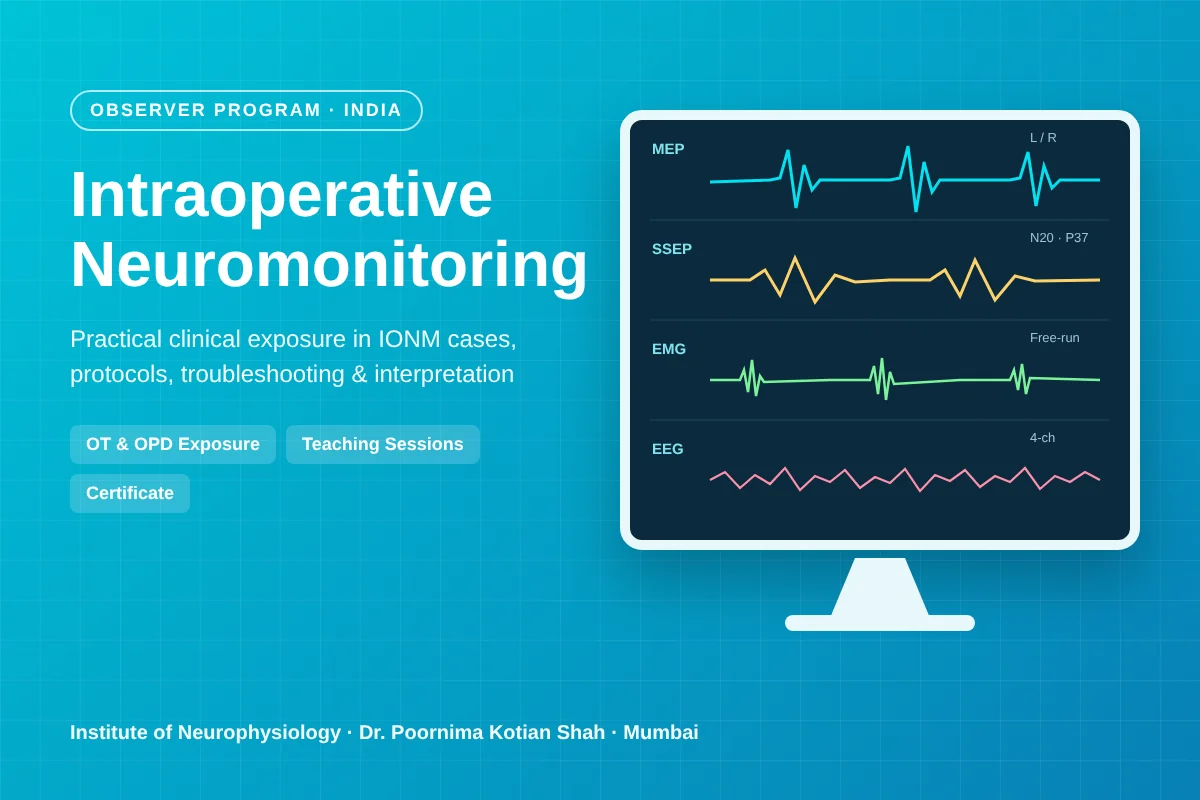
Intraoperative Neuromonitoring, commonly referred to as IONM, involves the use of neurophysiological techniques to monitor the nervous system during surgery. Depending on the surgical procedure and clinical requirements, different neurophysiological modalities may be used to assess neural pathways and their functional integrity.
IONM requires an understanding of:
- Neurophysiology
- Different monitoring modalities
- Appropriate monitoring protocols
- Technical considerations
- Signal interpretation
- Recognition of significant changes
- Troubleshooting technical problems
- Communication with the surgical team
Because IONM combines clinical knowledge with technical expertise, practical exposure can be an important part of developing competency in this field.
Why Consider an IONM Observer Program?
Learning IONM from textbooks and lectures provides a theoretical foundation, but observing real cases allows learners to understand how that knowledge is applied in clinical practice.
An observer program can help participants understand how an IONM workflow operates in a real-world environment, from preparation and protocol selection to monitoring, troubleshooting and interpretation.
The IONM Observer Program offered through the Institute of Neurophysiology is structured around this practical learning experience. Participants can gain exposure to a variety of IONM cases and understand how neurophysiological monitoring is incorporated into the clinical and surgical workflow.
What Will You Learn During the IONM Observer Program?
The program focuses on several important aspects of IONM and clinical neurophysiology.
1. Exposure to IONM Cases
Participants get exposure to a variety of IONM cases and can observe how monitoring is performed in real clinical scenarios. This helps bridge the gap between theoretical concepts and their practical application.
2. Understanding IONM Protocols
Choosing and implementing an appropriate monitoring protocol is an important part of IONM. The program provides exposure to the process of making IONM protocols and understanding the considerations involved in monitoring different cases.
3. Technical Expertise
IONM involves sophisticated equipment and technical workflows. Participants can develop an understanding of the technical aspects of monitoring, including the practical challenges that can arise during a case.
4. Troubleshooting
Technical problems and changes in signal quality can occur during neurophysiological monitoring. Understanding how to identify and troubleshoot these issues is an important aspect of practical IONM learning.
5. IONM Interpretation
Observation of real cases can help participants understand how IONM signals are interpreted in the context of the clinical and surgical situation. Teaching and practice sessions further support this learning process.
Who Can Benefit From an IONM Observer Program?
The program is intended for healthcare and neuroscience professionals who want to gain exposure to clinical neurophysiology and IONM. The current program is particularly relevant for:
- Neuroscience Technologists
- Physiotherapists
- Postgraduate students in Physiology
- Postgraduate students in Anesthesiology
- Postgraduate students in Neurology
- Postgraduate students in Neurosurgery
- Postgraduate students in Pediatrics
Professionals from related backgrounds who are interested in IONM and clinical neurophysiology may also enquire about their suitability for the program.
What Does the Observer Program Include?
The program is designed around clinical exposure and structured learning. Depending on the individual’s role and clinical setting, the observer experience includes:
- Hands-on exposure in OT and OPD
- Exposure to a variety of IONM cases
- Teaching sessions
- Practice sessions
- Maintaining a logbook
- Understanding IONM protocols
- Technical learning
- Troubleshooting
- IONM interpretation
The objective is to provide participants with exposure to real clinical work scenarios rather than limiting learning to classroom-based theory.
Where Is the IONM Observer Program Conducted?
The program is associated with clinical exposure at:
Goregaon Clinic
Dr. Poornima’s Neurodiagnosis Clinic
26/204, 2nd Floor, Shalimar Building,
Above McDonald’s, S.V. Road,
Goregaon West, Mumbai – 400104
Jaslok Hospital
The observer program also provides exposure at Jaslok Hospital, Mumbai. Dr. Poornima Shah is a Consultant Neurophysiologist at Jaslok Hospital and has undergone clinical neurophysiology training at the institution.
Learn Under the Guidance of Dr. Poornima Shah
Dr. Poornima Shah is a Consultant Clinical Neurophysiologist with expertise in Intraoperative Neuromonitoring, pediatric and adult EMG and EEG. She holds an International Diplomate certification from the American Board of Clinical Neurophysiology, along with additional certification in Intraoperative Neuromonitoring.
Her professional training includes clinical neurophysiology experience at Jaslok Hospital and visiting fellowships at institutions including the National Hospital for Neurology and Neurosurgery, Queen Square, London, and Hospital for Special Surgery, New York.
Dr. Poornima Shah has also been involved in establishing Clinical Neurophysiology departments at leading hospitals including Kokilaben Dhirubhai Ambani Hospital and Surya Hospital. This combination of clinical experience and specialised training provides participants with an opportunity to observe IONM within an established clinical neurophysiology practice.
How Can an IONM Observer Program Help Your Career?
A structured observer experience can provide several professional benefits.
- Practical Clinical Exposure: Develop a better understanding of how IONM works in actual clinical and surgical environments.
- Technical Understanding: Exposure to equipment, protocols and troubleshooting can help develop familiarity with the technical side of IONM.
- Certificate: A certificate is provided upon completion of the observer program.
- Networking: Working within a clinical environment provides opportunities to interact with professionals working in neurophysiology and related specialties.
- CV Building: Relevant clinical exposure and specialised training can strengthen a professional profile, particularly for individuals interested in pursuing a career involving neurophysiology or IONM.
- Career Opportunities: Exposure to IONM can help professionals better understand the field and make informed decisions about further training and career development.
Why Practical Exposure Matters in IONM
IONM is a field where theoretical knowledge and practical understanding need to work together. A learner may understand the principles of a particular neurophysiological modality, but observing how those principles are applied during an actual surgical case provides a different perspective.
For example, an observer can see how the team prepares for a case, selects an appropriate protocol, establishes monitoring, responds to technical issues and interprets changes in signals within the context of the procedure.
This type of exposure can help develop clinical thinking, technical awareness and familiarity with real-world workflows.
Frequently Asked Questions
Everything you need to know about the IONM Observer Program in Mumbai
What is the duration of the IONM Observer Program?
The standard observer position is one month. Shorter and longer duration options are also available.
Is this an IONM course or an observer program?
It is an IONM Observer Program focused on clinical exposure, teaching, practice and understanding real-world IONM workflows.
Who can join the program?
The program is intended for neuroscience technologists, physiotherapists and postgraduate students in areas including physiology, anesthesiology, neurology, neurosurgery and pediatrics.
Will I receive a certificate?
Yes. A certificate is provided upon completion of the observer program.
Where is the program conducted?
The program includes clinical exposure at Goregaon Clinic and Jaslok Hospital in Mumbai.
How can I enquire about the program?
You can contact the Institute of Neurophysiology for information regarding eligibility, duration options and other program-related queries.
Enquire About the IONM Observer Program in India
If you are a neuroscience technologist, physiotherapist, postgraduate student or healthcare professional interested in Intraoperative Neuromonitoring and Clinical Neurophysiology, the IONM Observer Program can provide an opportunity to gain exposure to real clinical workflows.
Contact for enquiries:
Institute of Neurophysiology – Dr. Poornima Kotian Shah
📍 Goregaon West, Mumbai
📧 doc_prk@yahoo.com
📞 98202 38329 | 93213 66625 | 88502 06356
Learn more about Dr. Poornima Shah and her clinical neurophysiology practice at drpoornimashah.com.
Conclusion
Intraoperative Neuromonitoring is a specialised field that combines neurophysiology, technology and clinical decision-making. For professionals looking to understand this field beyond textbooks and theoretical teaching, structured clinical observation can be a valuable learning experience.
The IONM Observer Program by the Institute of Neurophysiology, Dr. Poornima Kotian Shah, provides an opportunity to observe IONM cases, understand protocols, develop technical familiarity and gain exposure to real clinical work scenarios in Mumbai.